Learn Sudoku
Learn Sudoku
From your first single to advanced solving, learn to read the grid, recognize patterns, and build a repeatable solving process. Orbace teaches solving as a progression: fundamentals first, then increasingly sophisticated pattern recognition, then the study of real solves.
- Foundation
- Patterns
- Techniques
- Study
- Practice
Start here
Sudoku rules
A Sudoku grid holds one constraint, applied three ways. Everything else you will learn is a method for reading that constraint faster.
- 01 Each row contains the digits 1–9 exactly once.
- 02 Each column contains the digits 1–9 exactly once.
- 03 Each 3×3 box contains the digits 1–9 exactly once.
Sudoku is not arithmetic. Every given digit removes possibilities from its row, column and box, and every valid placement follows from what has been removed. A well-formed Orbace puzzle has exactly one solution and never requires a guess.
Method
How to solve Sudoku: a solve is a chain of reasons
Stronger solving is not guessing faster. It is extracting more information from the same grid before making a move.
Each loop of the cycle below leaves the grid more constrained than it found it. When a puzzle stalls, the missing step is almost always an unread constraint rather than a missing technique.
- 01
Scan
Look for the digit already placed the most — it constrains the most cells.
- 02
Find constraints
Check what each empty cell's row, column and box already rule out.
- 03
Place certain digits
Fill the cell when exactly one legal possibility remains.
- 04
Update candidates
Remove the placed digit from every affected cell immediately, everywhere.
- 05
Recognize patterns
Relationships between candidates.
- 06
Repeat
A smaller grid than before.
Technique ladder
Sudoku solving techniques
Ordered by what they ask of you. Each rung stays useful after you climb past it.
01 · Foundation
Place what is certain
Direct placements and the note-keeping habits that make everything later possible.
02 · Intersections
Use where lines meet
The first eliminations that come from a relationship rather than a single cell.
03 · Sets & patterns
Read groups of cells
Several cells that must share a set of digits, and the fish patterns that follow.
04 · Advanced reasoning
Follow a chain
Test an assumption, follow its consequences, and let a contradiction do the work.
Latest Su-Pu Study
Learn from real Sudoku solves
A Journal study reconstructs the decisions of one real solve, not the definition of a technique.
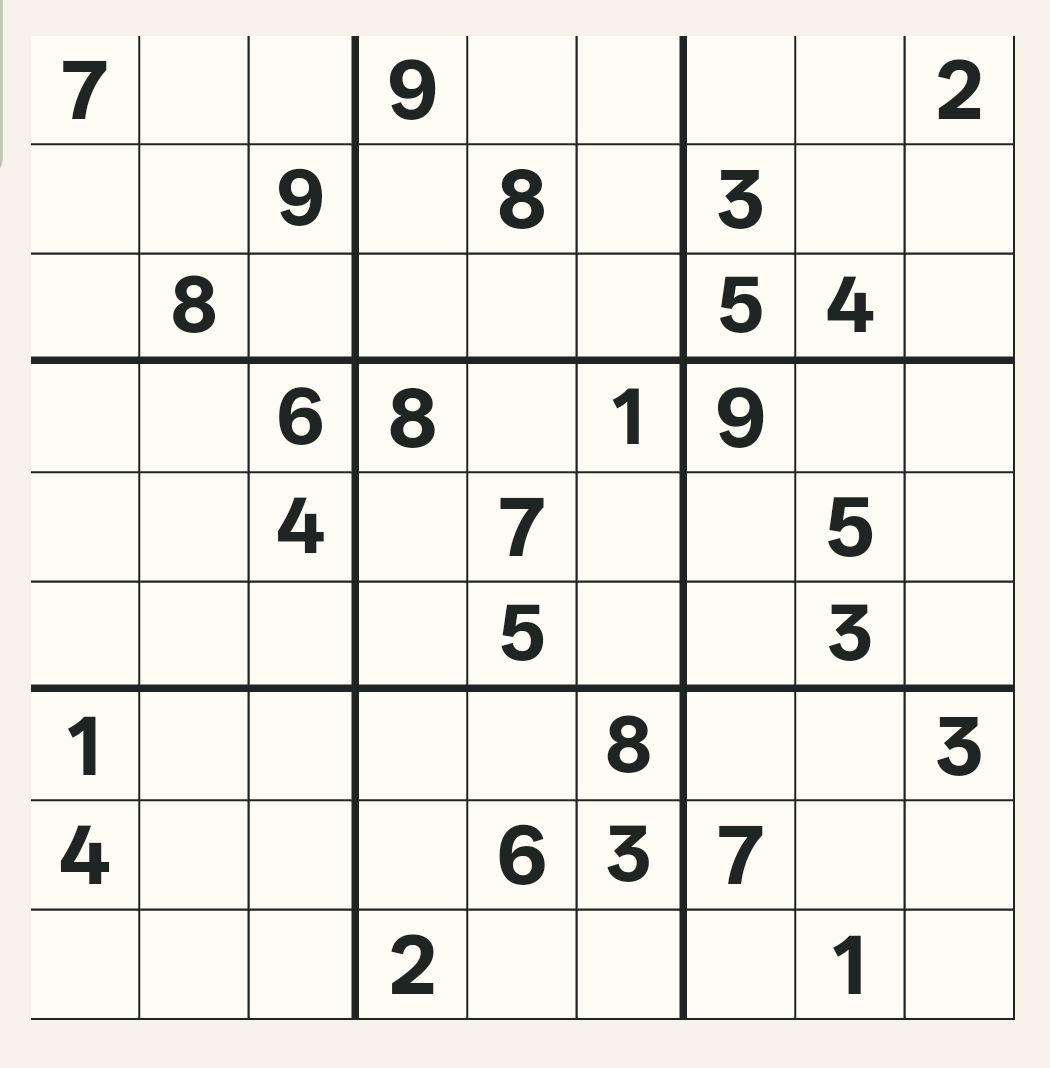
Solution Space, Not Candidate Space
Why ibtree's pencil digits trace a trial solution forward, not every possible candidate in every cell.
The learning system
From study to practice
One idea travels through three places in Orbace. Learn holds the explanation, Journal holds the evidence, Puzzle Packs holds the repetition.
Learn
Understand the idea
Read what the pattern claims and which eliminations it licenses.
Strategy Library →Study
See it in a real Su-Pu
Watch where an expert noticed it, and what they tried first.
Journal studies →Practice
Try it in Puzzle Packs
Solve grids chosen to require the idea you just read about.
Puzzle Packs →Puzzle Packs
Practice Sudoku techniques
Random Sudoku gives you more puzzles. It does not give you more of the puzzle you are currently bad at. Packs are grouped by difficulty and by the technique a grid actually demands, so a session can be aimed at one weakness instead of averaging over all of them.
Practice deliberately: pick the pack that matches the rung you are working on, and stop when the reason for each placement becomes automatic.
Su-Pu
Review your solve
A finished grid shows the answer. Su-Pu shows the journey.
A solve record keeps the order of your moves, so the parts of a puzzle you cannot remember afterwards are still there to read.
- Where progress accelerated, and what you had just placed.
- Where you stalled, and how long the pause lasted.
- Which techniques appeared, named as they occurred.
- How another player's route through the same grid differed.
Questions
Frequently asked questions
How do you play Sudoku?
Fill every empty cell so that each row, each column and each 3×3 box contains the digits 1 to 9 exactly once. You never add or multiply anything; you work out which digits a cell can still legally hold, and place one when only a single possibility remains.
What is the best way to start solving a Sudoku?
Scan for the digit that already appears most often. Its existing placements constrain the largest number of rows, columns and boxes, so it is the digit most likely to produce a certain placement without any notation at all.
Do you need to guess in Sudoku?
No. A well-formed puzzle has one solution reachable by logic alone. Testing an assumption and following it to a contradiction is not guessing — the contradiction is the proof, and the elimination it produces is valid regardless of how it was found.
What should I learn after singles?
Intersections. Pointing pairs and box/line reduction are the first techniques that eliminate a candidate without placing a digit, and they teach the habit every later technique depends on: treating an elimination as progress.
How do candidates work?
A candidate is a digit a cell could still legally hold. Note them only when direct scanning stops paying, and update them immediately after every placement — a stale candidate list produces confident wrong moves faster than no notes at all.
How can I practice harder Sudoku?
Choose a Puzzle Pack built around the technique you are learning rather than raising the difficulty rating. Harder grids do not teach a pattern; grids that require the pattern do.
What is Su-Pu?
Su-Pu is Orbace's solve record. It preserves the sequence of a completed puzzle — placements, corrections and pauses — so a solve can be replayed and studied instead of only scored.