Two Homes for a Nine
When basic methods stall, look for a binary fork—two candidates in one box—and trace one forward to find your proof by contradiction.
In this study
01 · Opening
The starting grid
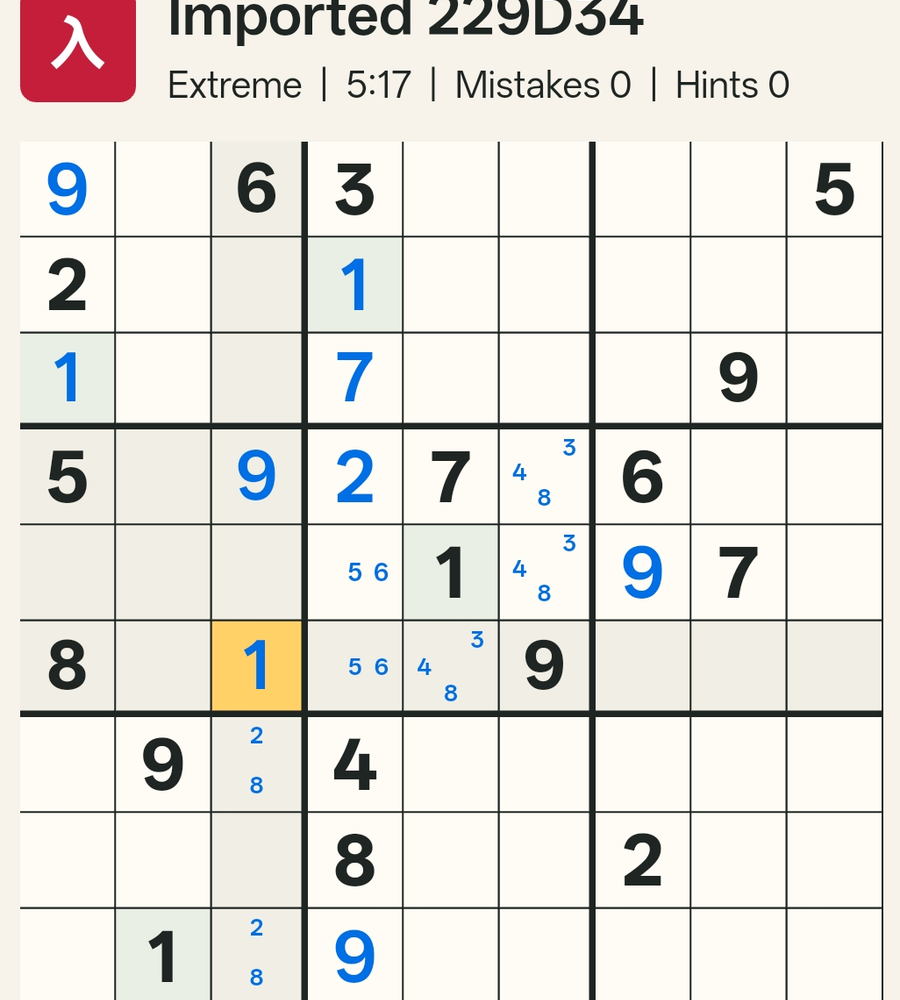
Let's take a close look at this Extreme-tier puzzle. At first glance, it seems impossible to place a single digit using only basic Sudoku methods—no naked singles leap out, no obvious hidden singles present themselves. You could fill the entire grid with candidate pencilmarks and systematically reduce them until a naked single appears, but even that won't get you very far. The puzzle demands something more.
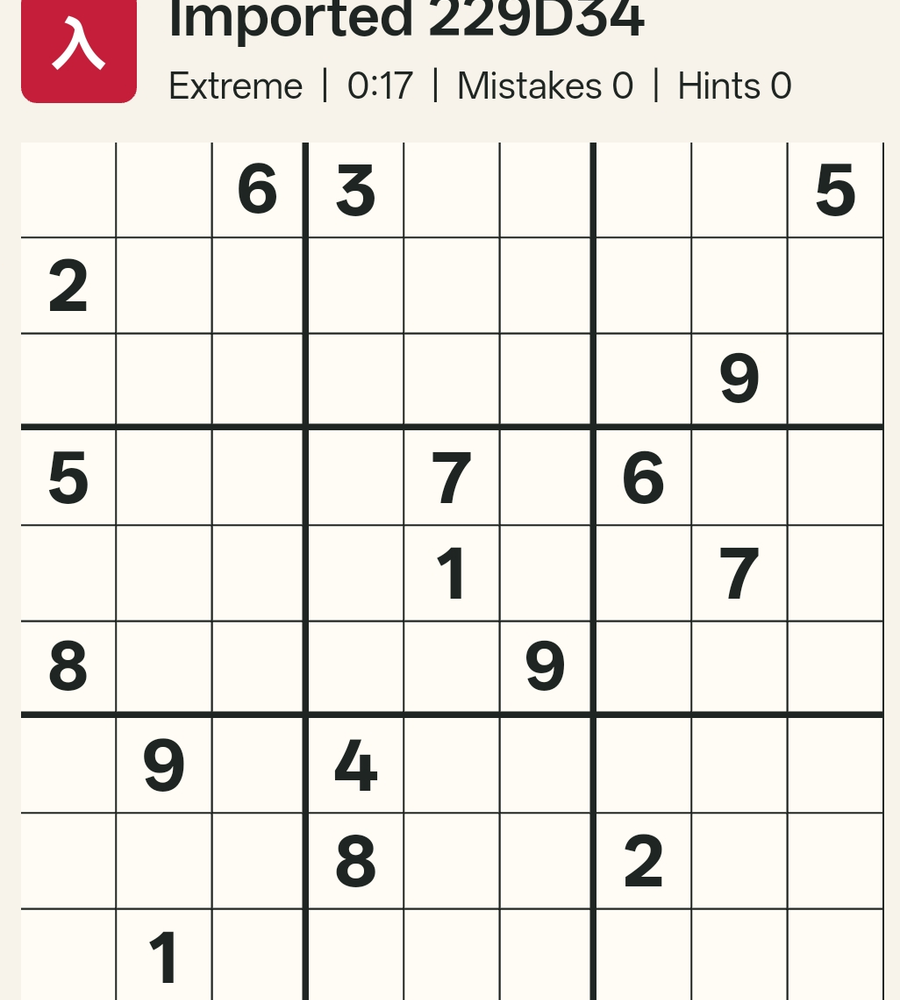
Sudoku puzzles can be solved creatively by looking at the special formation of the givens—the structural opportunities they create. This puzzle is a perfect example.
02 · Opportunity
Finding the fork
Observe Box 1 (the top-left box). There are only two possible homes for the digit 9: one cell in the top row, and one cell a row below. This is a binary fork—exactly two candidates for the same digit in the same region. It's the structural trigger the ibtree method looks for.
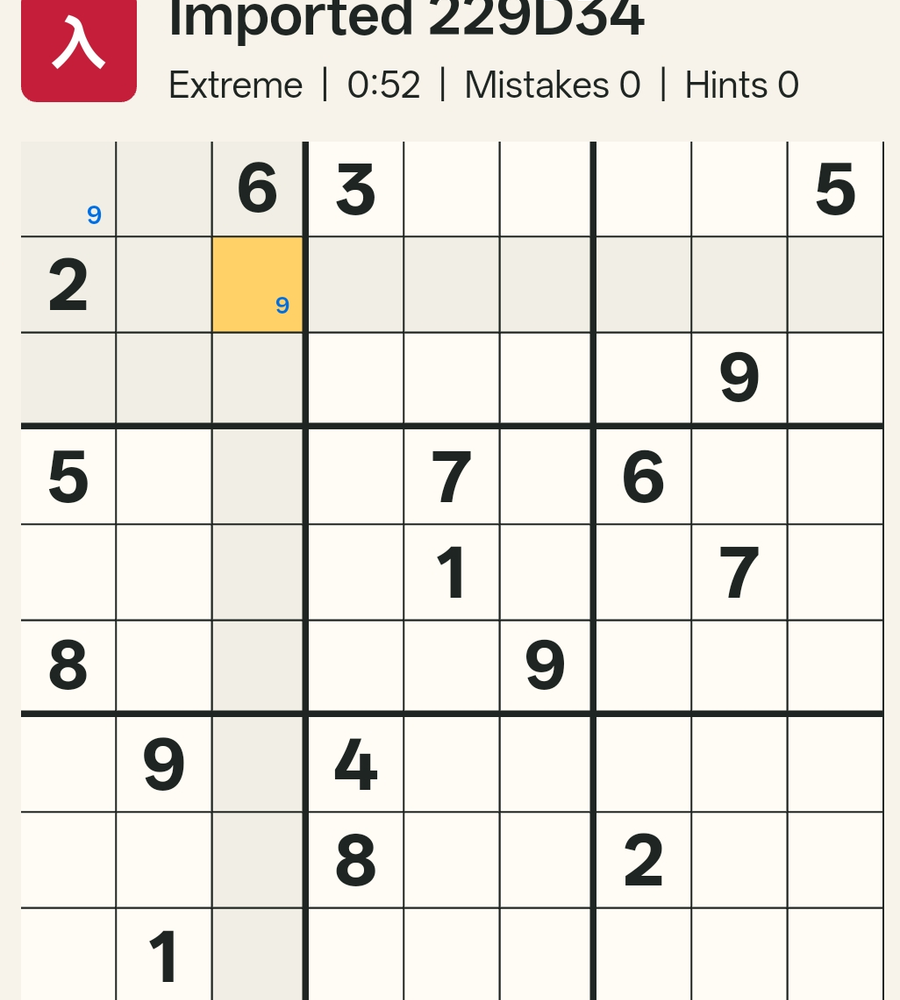
One of these two cells must hold 9—Sudoku's rules guarantee it. That means if we assume one candidate is true and reach a logical contradiction, we've proven the other candidate must be correct. This is proof by contradiction, the logical foundation of the ibtree method.
03 · Trace
The false branch
Let's assume 9 is in the highlighted cell (R2C3) and trace forward. What happens next?
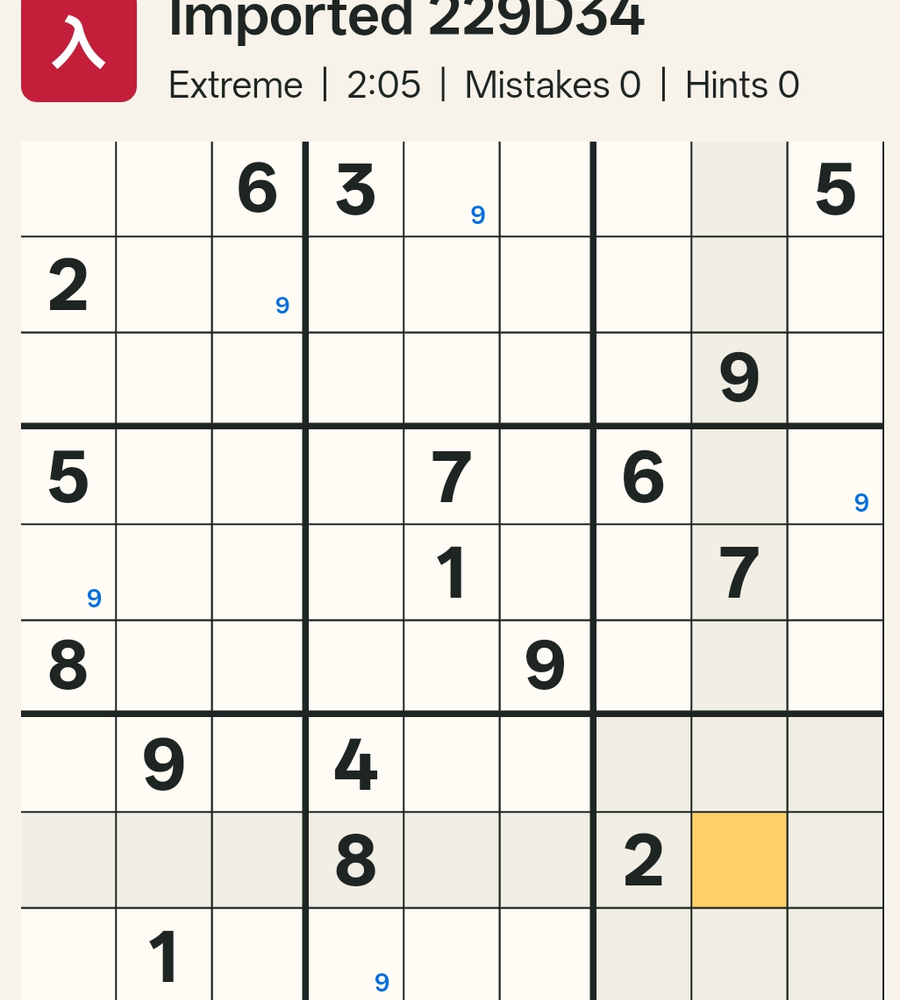
This assumption triggers a chain reaction—a sequence of forced placements where each step leaves only one legal option for the next digit. After merely five steps, the chain reaches a contradiction: two 9s would occupy the same row, violating Sudoku's fundamental rule. The assumption was false.
The Orbace rule for choosing a branch: When you find a binary fork (two candidates for the same digit in one box), pick one and trace it forward. If it leads to a contradiction in a reasonable number of steps, you've proven the other candidate is correct. If it doesn't contradict quickly, backtrack and try the other branch—the puzzle's unique solution guarantees one path will resolve.
04 · Proof
The confirmation
By the logic of proof by contradiction, if R2C3 cannot hold 9, then the other candidate in Box 1 must be correct. The 9 belongs in the top-left corner.
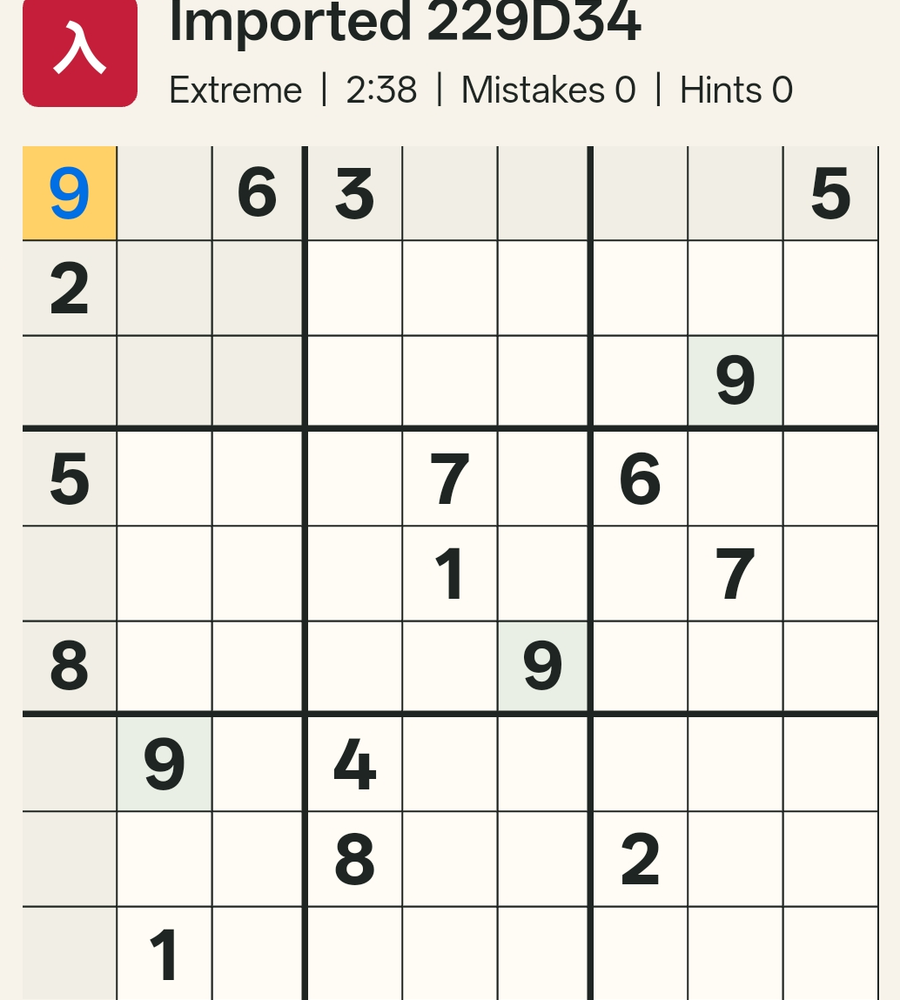
After this one determination, the puzzle downgrades dramatically. What was an Extreme-tier wall becomes a straightforward solve using basic techniques—hidden singles, naked pairs, the standard toolkit. By identifying the binary fork and tracing one branch to its contradiction, you've leveraged the puzzle's structure to crack it open in seconds.
05 · Contrast
Ibtree versus canred
Had you decided to use the traditional candidate reduction (canred) method instead, you would have needed to fill the grid with pencilmarks, then hunt for an advanced pattern—in this case, a sashimi swordfish on the 9s—to eliminate the same R2C3 candidate the ibtree method disproved in five steps. The sashimi swordfish is itself a valid theorem, but its logical proof is based on exactly the same principle: proof by contradiction.
| Ibtree | Candidate reduction |
|---|---|
| Focus on structural opportunity—find a binary fork and trace one branch forward. | Focus on systematic elimination—fill all candidates, then apply increasingly advanced patterns. |
| Opportunistic: either you pick the correct branch (leading directly to the solution) or the false branch (leading to a quick contradiction). | Deterministic: every step removes candidates until a single digit is certain. |
| Faster in most cases, especially under time pressure (tournaments, competitions). | Thorough and methodical, but slower when advanced patterns are required. |
| Not guessing—still rigorously based on logical proof by contradiction. | Also rigorous, but the proof is encoded in the pattern names (swordfish, XY-wing, etc.) rather than traced explicitly. |
Comparing these two approaches reveals they operate in fundamentally different modes of thinking. Ibtree leverages the puzzle's structure to generate a chain reaction—you either prove or disprove a choice by tracing its consequences. Canred applies a library of reduction rules to answer what numbers are not possible in each cell, narrowing the field until certainty emerges.
Both are valid. But ibtree is faster when the puzzle offers a clear fork, and it's the method of choice in time-constrained settings like Sudoku tournaments.
06 · Structure
Why "binary tree"?
We call this method a binary tree because it constructs a dynamic solution tree as you solve. Each fork—each choice between two candidates—is a branch point. When you trace one branch and reach a contradiction, you prune that sub-branch and confirm the other. The tree grows forward as you identify new forks, and proof by contradiction keeps it from growing out of control.
This diagram shows the fork at the top—Box 1's two candidates for 9—and the two branches descending from it. The left branch (red) traces the false assumption to its contradiction. The right branch (green) confirms the correct placement. This is the shape every ibtree solve takes: identify the fork, trace one branch, prune or confirm.
Try it yourself
The next time you face an Extreme-tier puzzle that seems to stall, scan for a binary fork—two homes for the same digit in one box. Pick one, trace it forward, and see where it leads. You might just unlock the whole grid in seconds.
Solve a Tea Moment puzzleReconstructed from a real personal Su-Pu replay and checked against the recorded grid. Spotted a step that doesn't hold up? Tell us—every Journal article carries an accountable byline and an open correction channel.